
Audit Overview
Your store's untapped revenue potential — and how to unlock it
Why We Created This Audit
We analyzed greensoul.online the same way we've audited 350+ e-commerce stores — looking for the specific gaps between your current experience and what top-performing Home & Living stores deliver. Every finding in this report is a revenue opportunity backed by industry data and competitive benchmarks.
What We Analyzed
- UX & Conversion Design8 findings
- Performance & Speedvs 4 competitors
- Technology & App StackPlatform + 12 apps
- Industry BenchmarksHome & Living
Pages Analyzed
- Homepage2 findings
- Collection Pages2 findings
- Product Pages (PDP)2 findings
- Cart & Checkout2 findings
 This audit was prepared by Growisto — a CRO-led Website development team behind 167% conversion growth for Atomberg, 46% CR lift for TyresNmore, and 350+ e-commerce projects.
UX & Conversion Findings
Page-by-page analysis with visual comparisons against top Home & Living stores
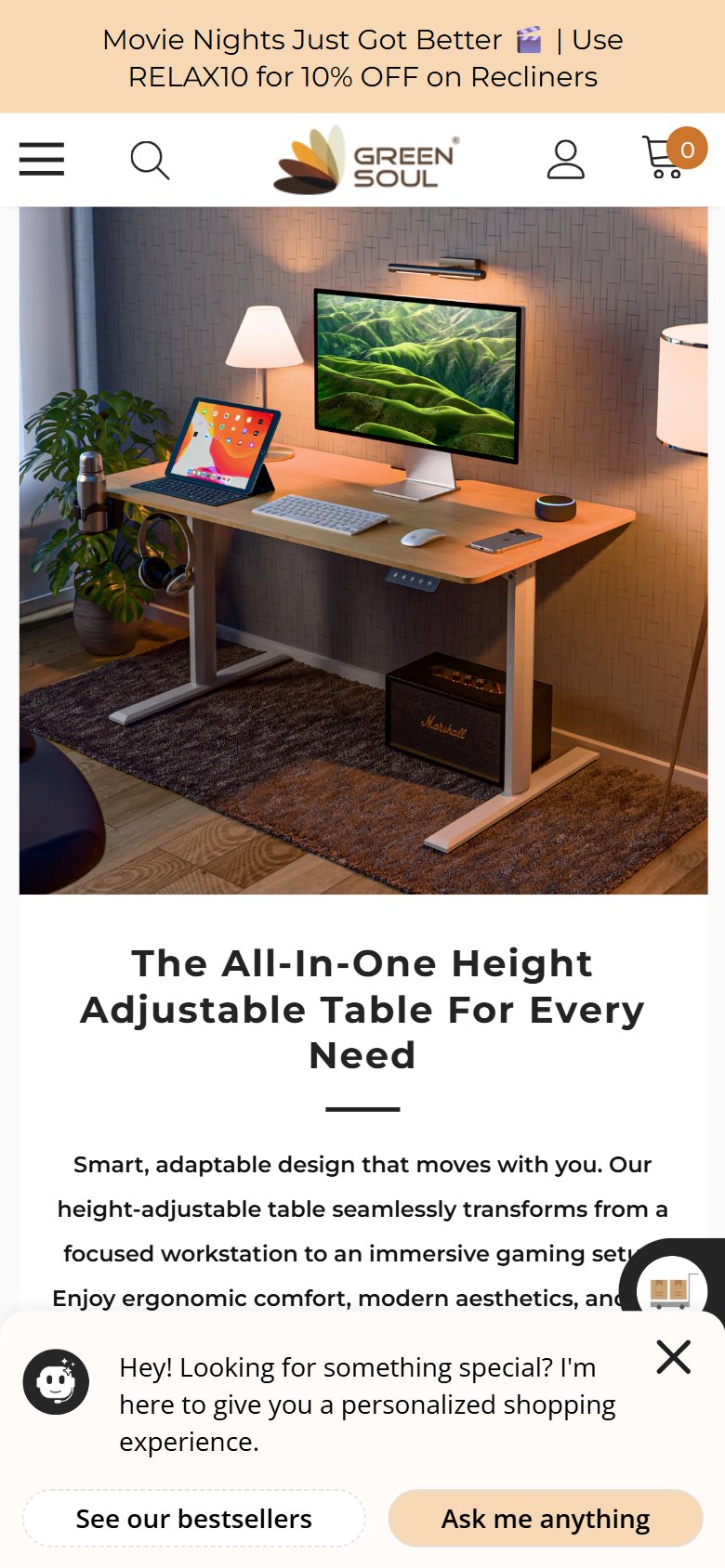
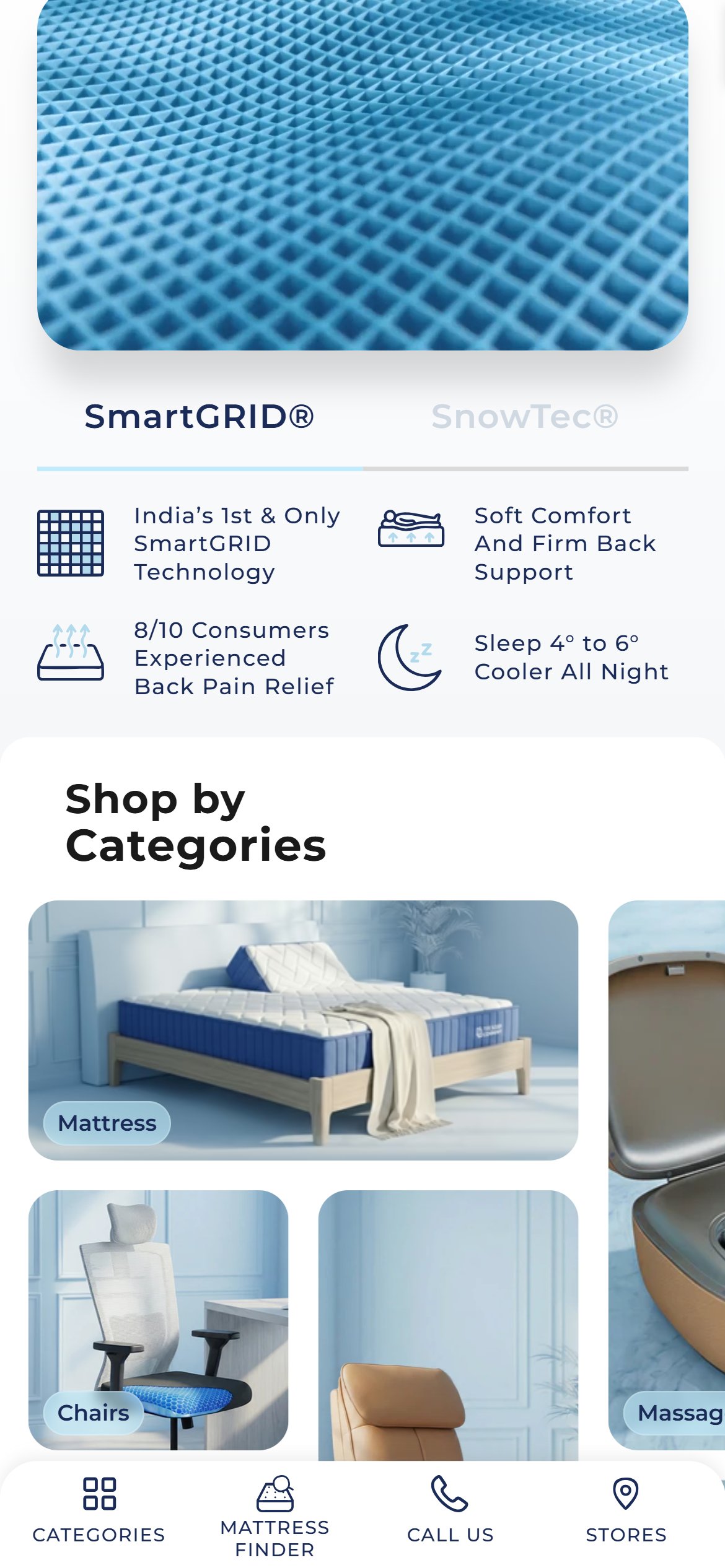
- The mobile homepage flows hero → brand headline → marketplace review logos → bestsellers → long-form SEO copy, with no compact icon strip communicating the operational USPs that reduce first-purchase hesitation.
- Green Soul's strong assurances — Free Shipping, 5-Year Warranty, No-Cost EMI, Free Installation, 30-day returns, BIFMA-certified — are only shown once the user reaches a product page.
- For a high-consideration ₹8,000–₹35,000 furniture purchase, surfacing these trust cues above the fold removes friction before the shopper has chosen a product.
- A persistent benefit bar near the top of the homepage is a standard pattern across leading India furniture stores.
- Add a slim, persistent USP/benefit icon strip directly under the hero: Free Shipping · No-Cost EMI · 5-Yr Warranty · Free Installation · Easy Returns.
- Keep it icon-led and tappable so each cue links to the relevant policy/help page.
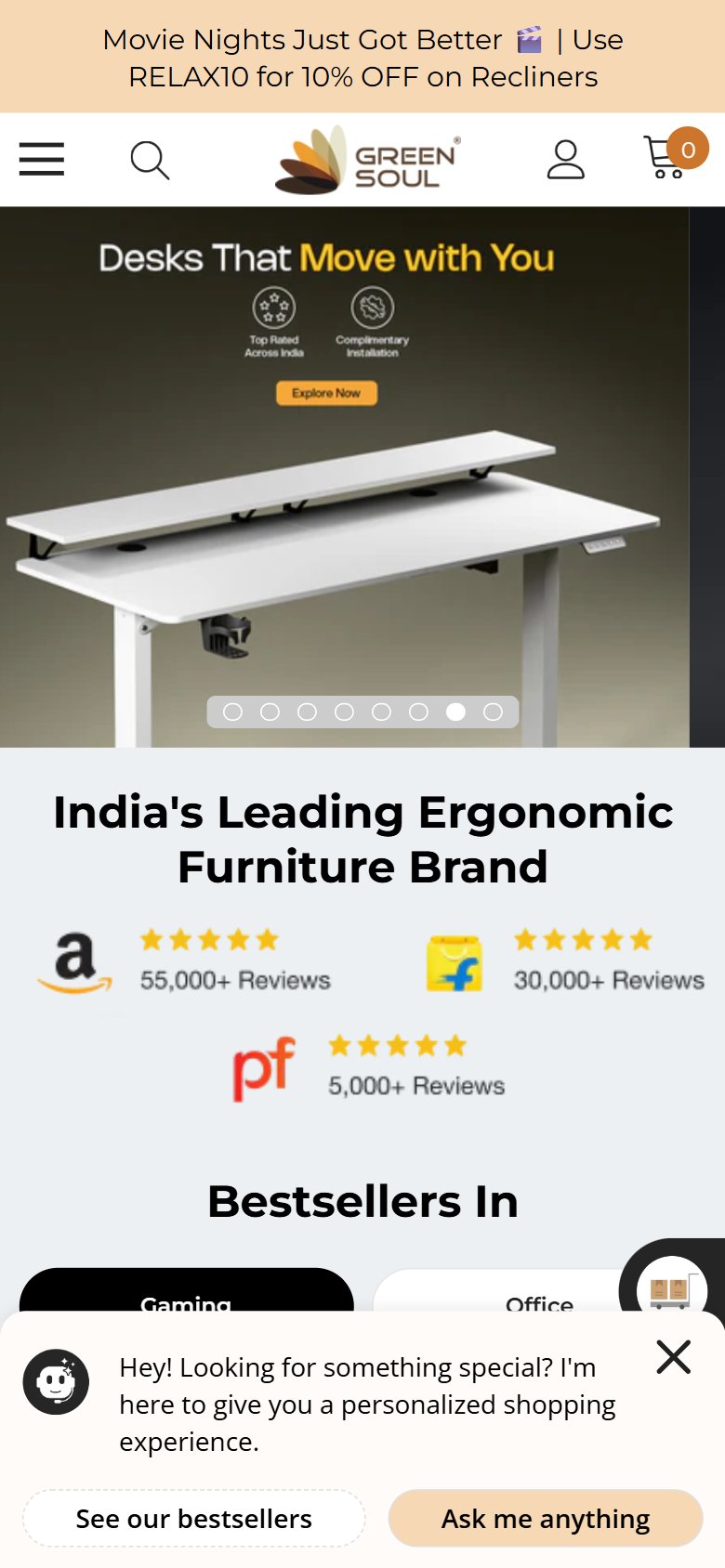
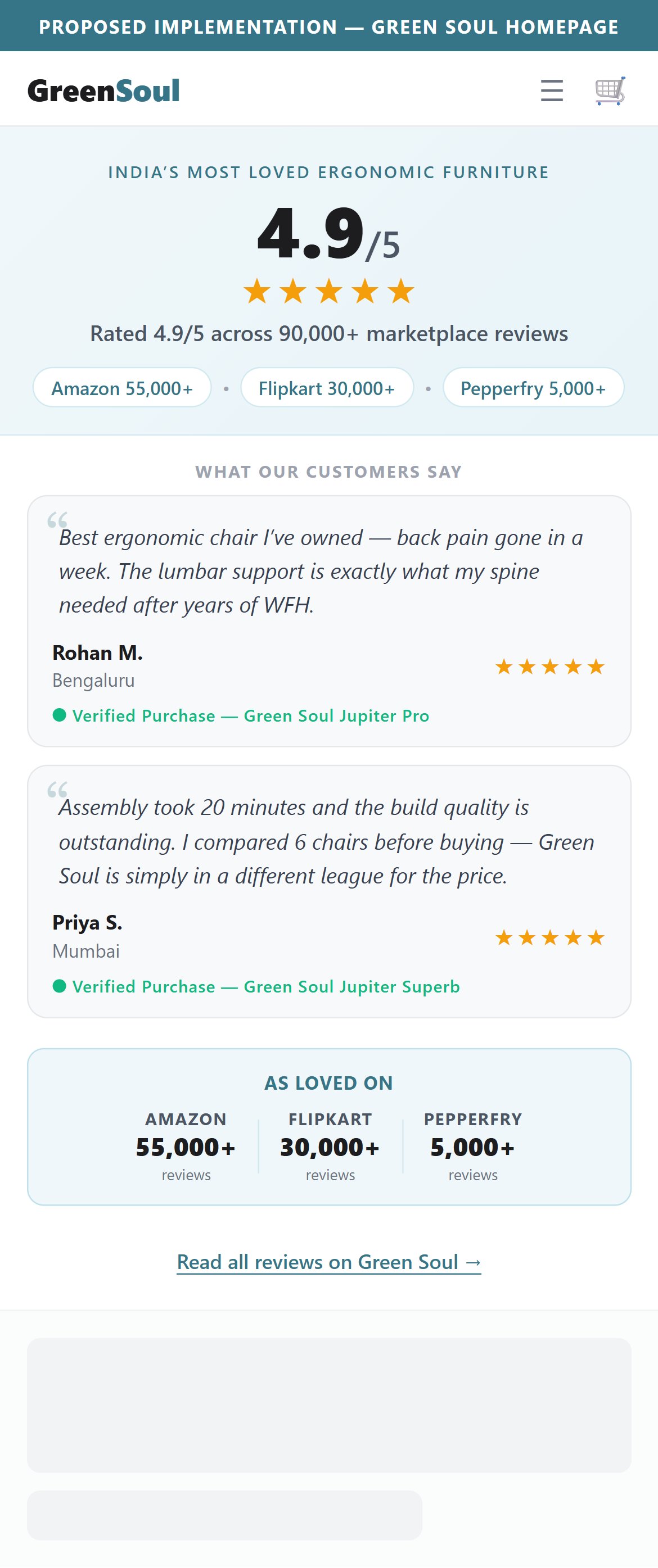
- The homepage's main proof element is a row of marketplace logos (Amazon 55,000+, Flipkart 30,000+, Pepperfry 5,000+ reviews — over 90,000 ratings combined) — strong, but it sends trust signals off-site rather than reinforcing Green Soul's own store.
- There is no on-site aggregate star rating, named customer testimonials, or shoppable UGC/lifestyle gallery on the homepage, even though product pages carry rich Judge.me reviews (e.g. 4.90 out of 5 from 89 reviews).
- Review volume is a documented competitive moat in home & living; bringing that proof on-site keeps the shopper on Green Soul at the moment of decision.
- Top home & living stores foreground their own review counts and testimonials on the homepage, not only third-party logos.
- Add an on-site social-proof band: aggregate store rating + review count, 2–3 rotating verified testimonials, and an 'as loved by creators' UGC strip (Green Soul already has influencer content on PDPs).
- Link the band to the full reviews so the proof is verifiable on-site.
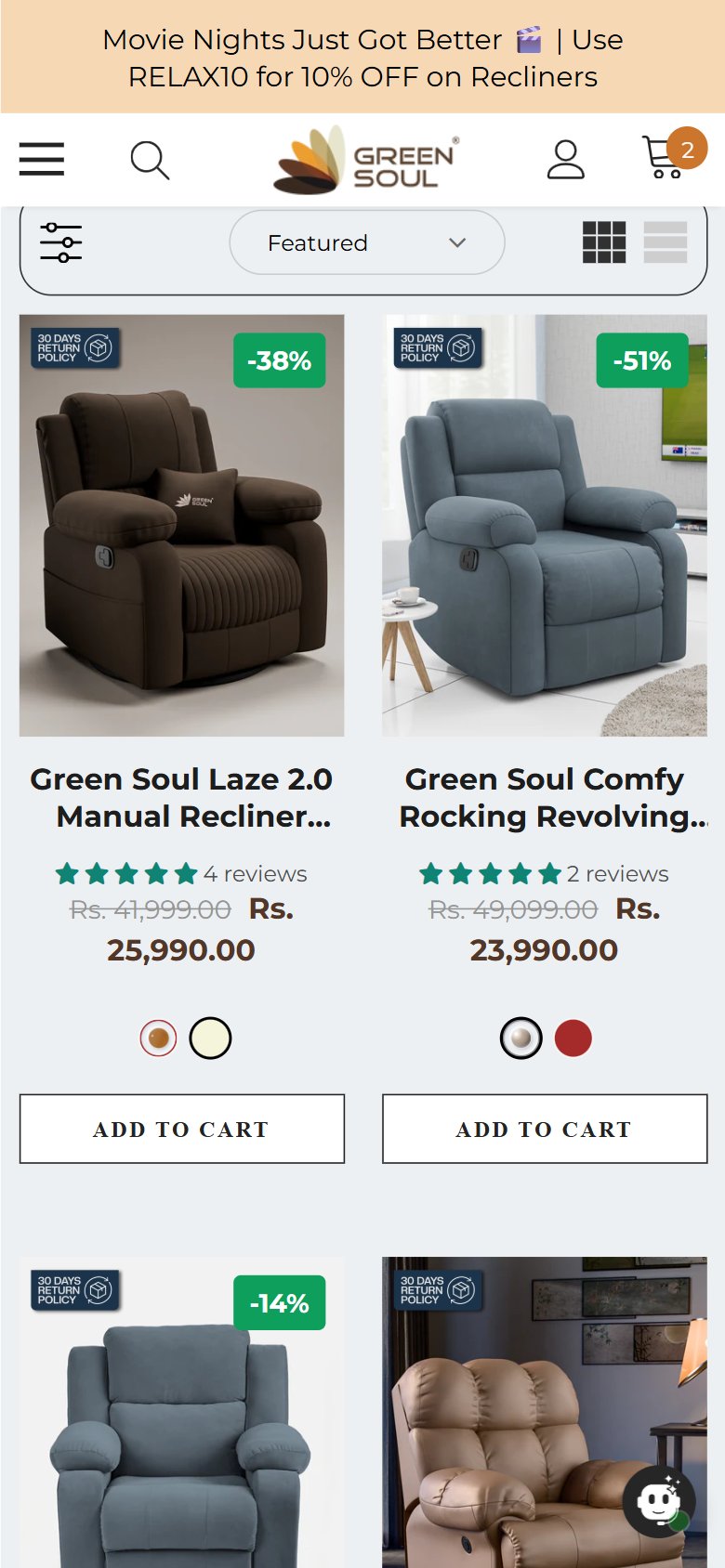
- Collection cards are otherwise rich — rating, review count, MRP strikethrough, sale price, colour swatches, Add to Cart and Add to Compare — but there is no quick-view / quick-look affordance.
- Green Soul ranges run 15–30+ near-identical chair models per collection, so shoppers must open and back out of many PDPs to compare specs and images.
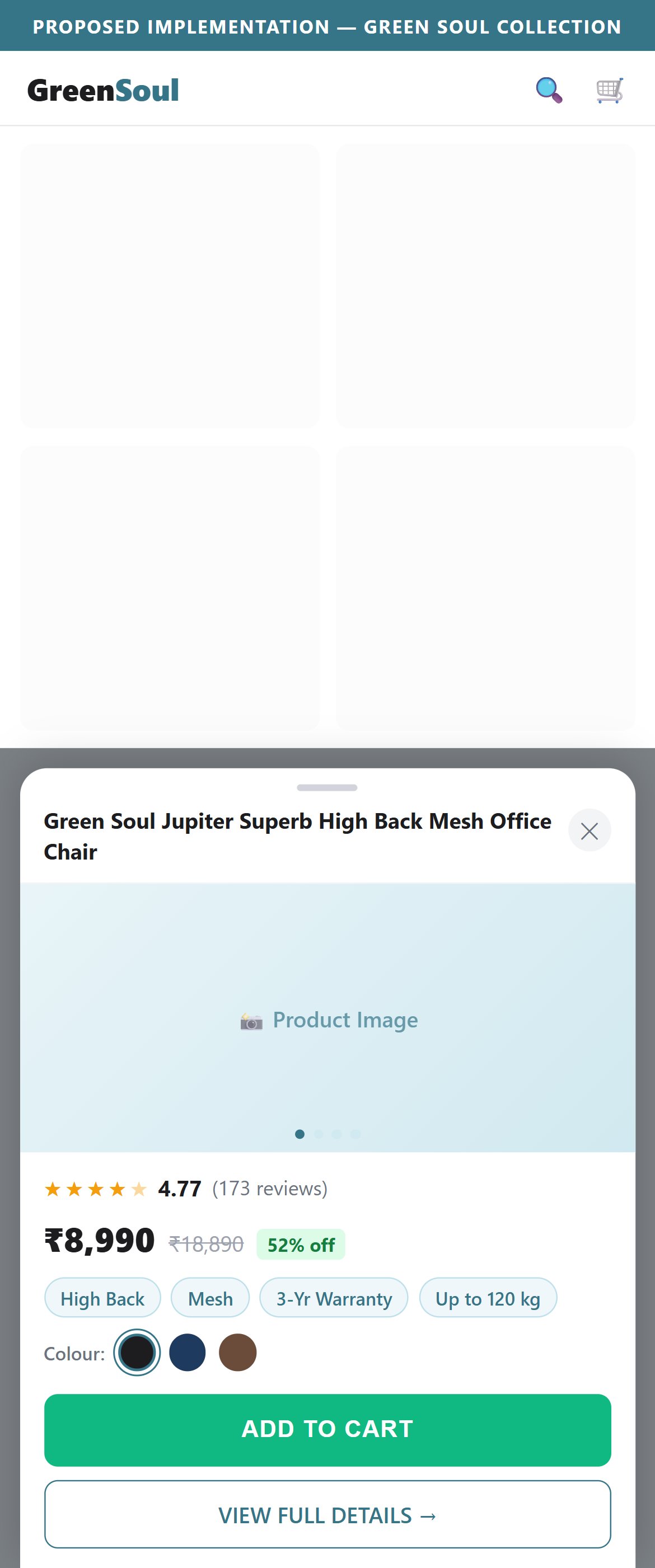
- A quick-view overlay (key specs, image gallery, variant + ATC) lets users evaluate several models in one session without losing scroll position.
- Quick view is a growing mobile merchandising pattern for wide, similar catalogues.
- Example implementation uses a representative chair (4.77 stars, 173 reviews) priced at ₹8,990 (MRP ₹18,890, 52% off) to illustrate the overlay pattern.
- Add a quick-view overlay on cards surfacing image gallery, key specs/dimensions, variant selector and Add to Cart.
- Pair it with the existing Compare feature so shoppers can shortlist without leaving the collection.
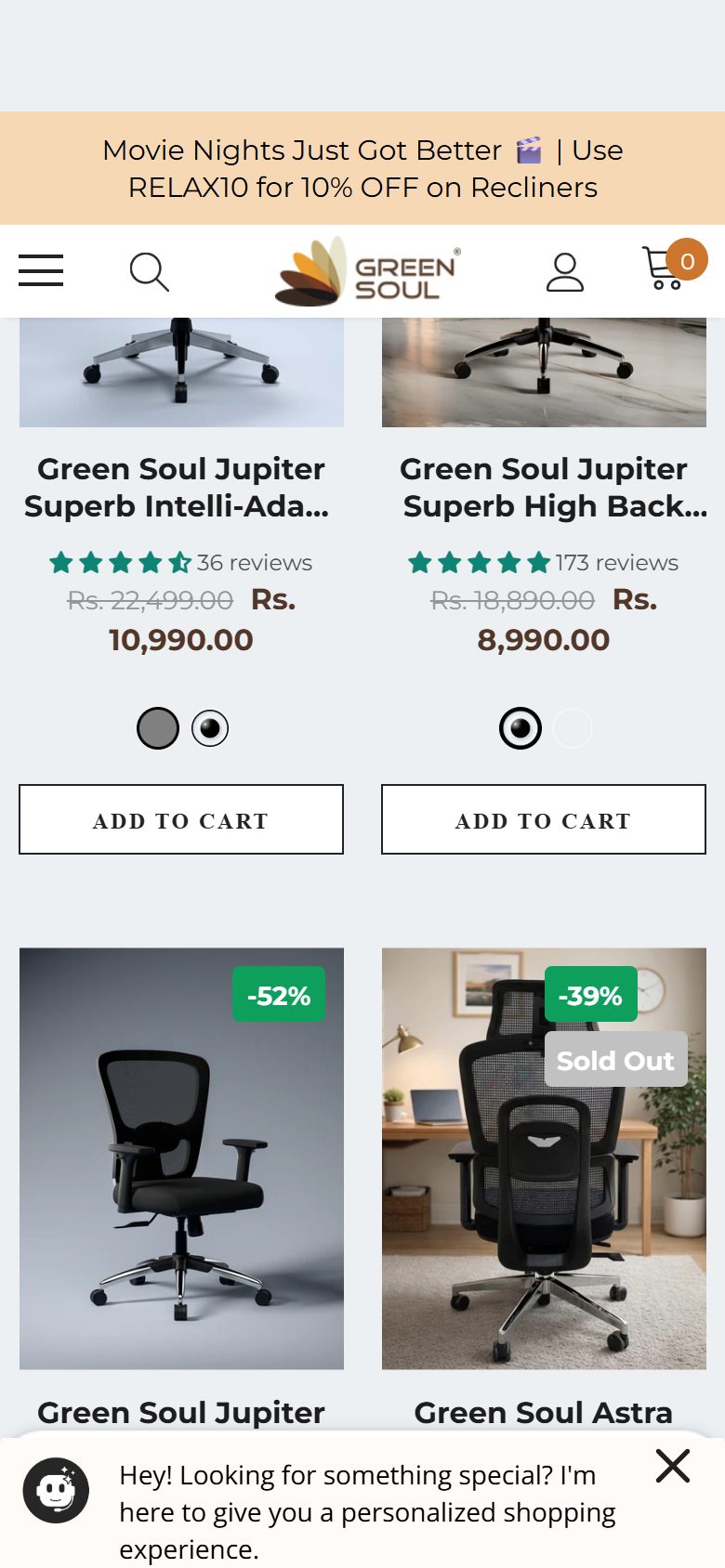
- Out-of-stock models (e.g. Green Soul Astra) are clearly marked 'Sold Out' with a disabled button — good handling — but offer no way to register interest.
- With no 'Notify Me when back in stock' capture, interested shoppers leave with no follow-up hook and the demand is lost.
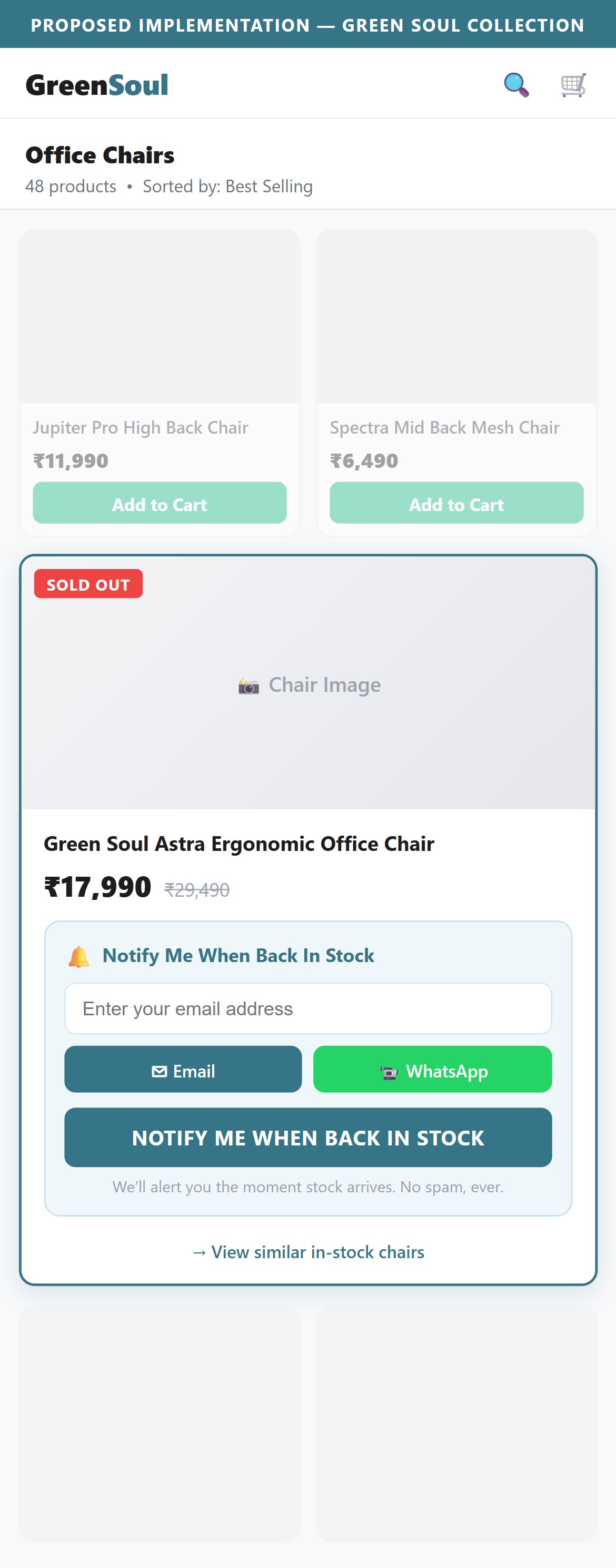
- An email/WhatsApp restock alert converts a dead end into a captured lead and a future sale, and signals demand for restocking decisions.
- Restock-alert capture is still a differentiator in the category — an easy edge over competitors.
- Example implementation uses representative in-stock chairs (e.g. Jupiter Pro at ₹11,990 and Spectra at ₹6,490) alongside a sold-out Astra (₹17,990, MRP ₹29,490) to illustrate the notify-me pattern.
- Replace the disabled state on sold-out items with a 'Notify Me' email/WhatsApp capture (on both card and PDP variant).
- Trigger an automated back-in-stock message when inventory returns.
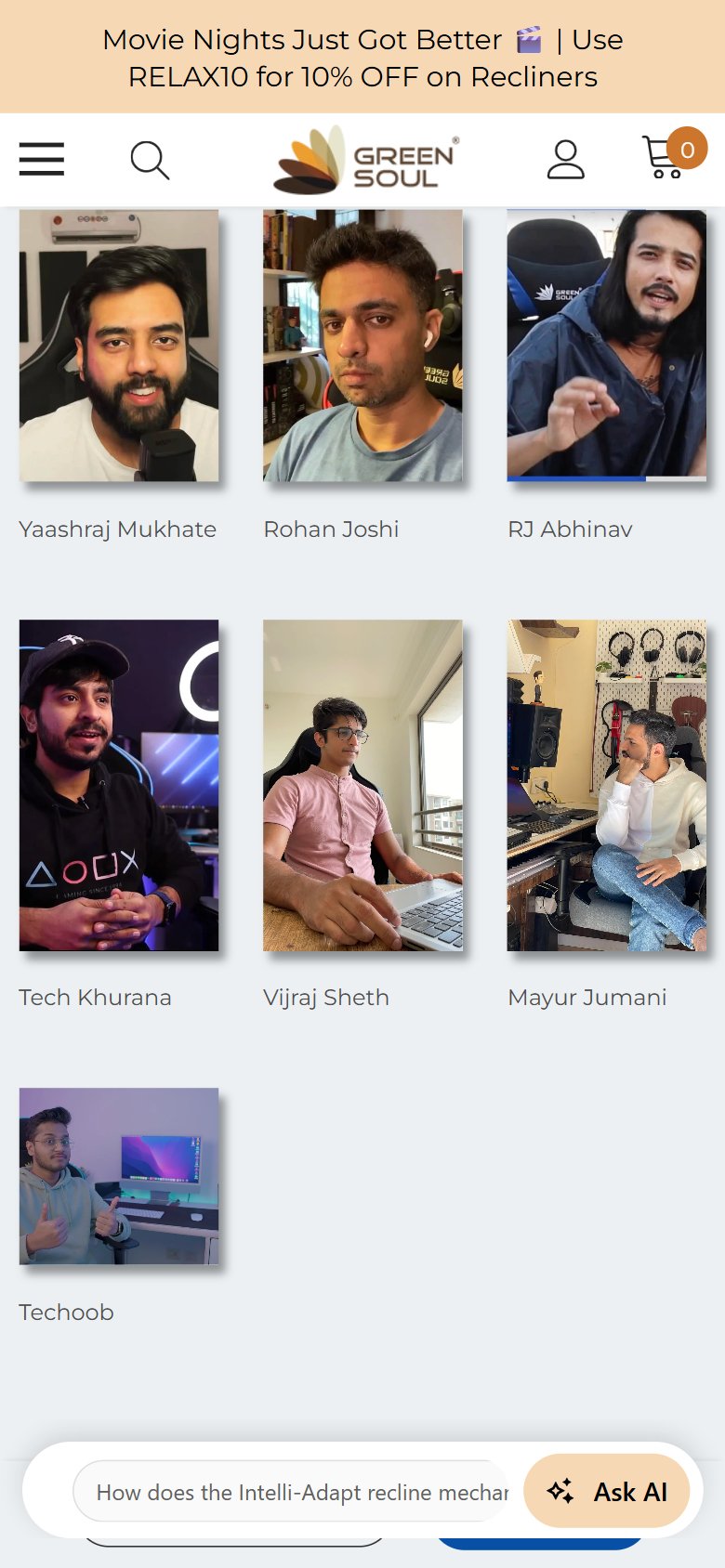
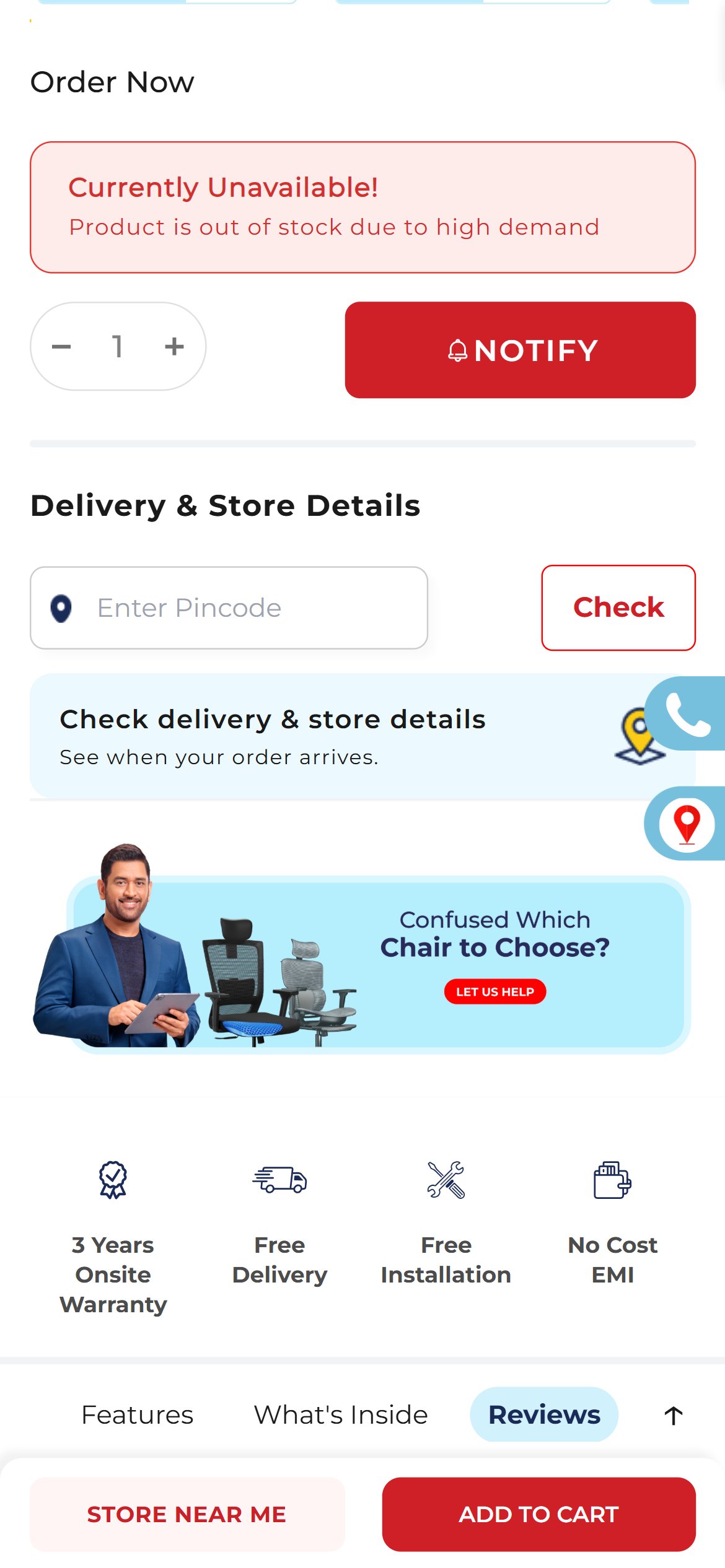
- The mobile PDP is very long (description, Features/Specs/Item Details accordions, an 'Ask AI' assistant, reviews and an influencer wall) — well over 6,000px tall.
- Inspection shows the theme includes a 'sticky-add-to-cart' button, but it is rendered with position:static and empty content — it scrolls away with the page instead of staying pinned.
- Once the shopper scrolls past the inline Add to Cart / Buy It Now, the only persistent bottom element is the 'Ask AI' bar — re-purchasing requires scrolling all the way back up.
- A functional sticky ATC keeps the primary action one tap away throughout a long PDP — a high-leverage mobile fix since the markup already exists.
- Fix the existing sticky-add-to-cart component: make it position:fixed, populate the price + variant + Add to Cart, and reveal it after the inline ATC scrolls out of view.
- Ensure it does not collide with the 'Ask AI' bar (stack or offset).
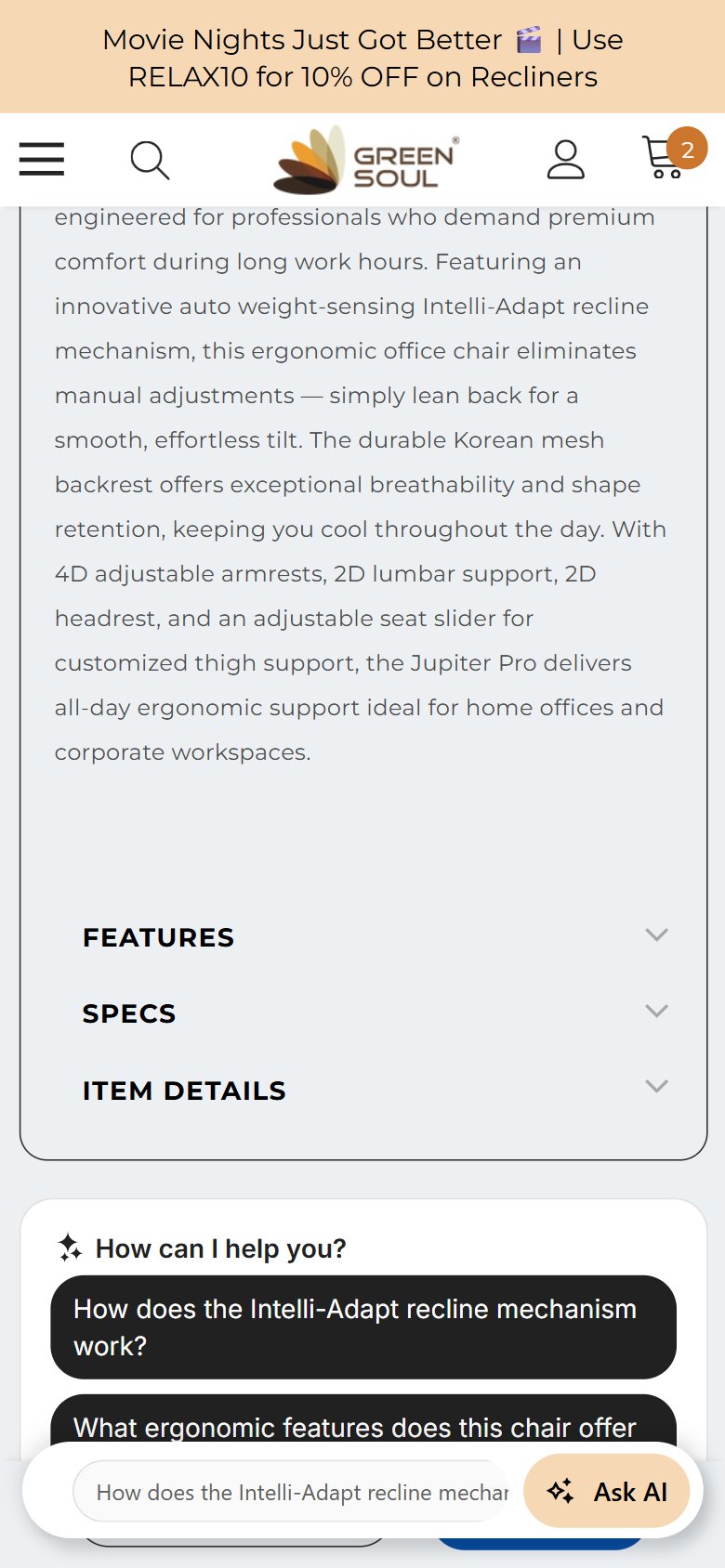
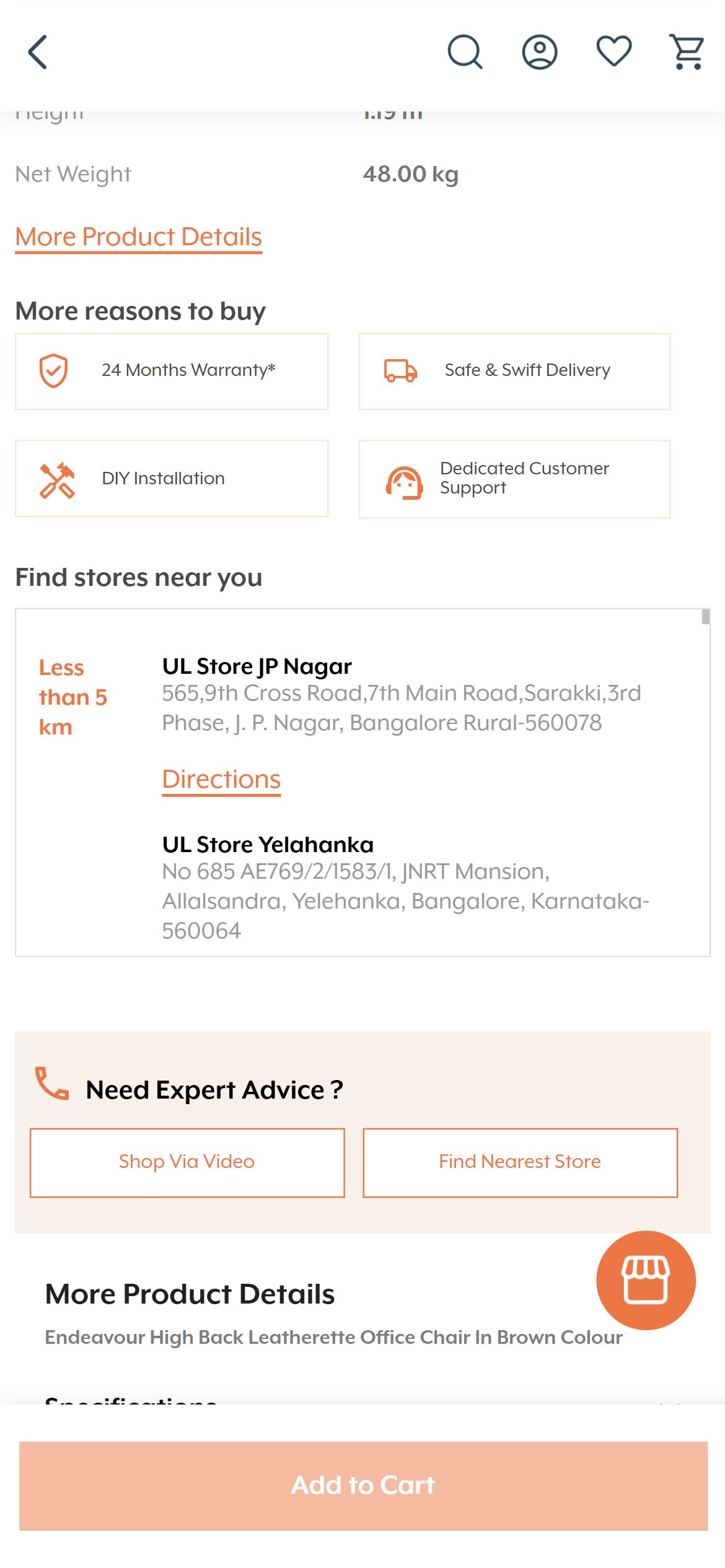
- Below the prose description the PDP exposes three accordions — FEATURES, SPECS, ITEM DETAILS — all collapsed by default, so no specifications or dimensions are visible without extra taps.
- For furniture, dimensions (seat height/width, overall footprint, weight capacity) and materials are decisive purchase information — benchmark guidance flags dimension info as critical on home & living PDPs.
- There is no scannable spec/dimension panel or measured diagram near the top of the page; the shopper must hunt for fit-critical data.
- Surfacing a compact spec/dimension block (or a labelled dimension diagram) reduces sizing uncertainty, a leading cause of furniture returns and abandonment.
- Add an at-a-glance spec panel high on the PDP: key dimensions, weight capacity, materials, warranty and recline/adjustment range, as labelled icons or a compact table.
- Include a measured dimension diagram for chairs and tables so shoppers can judge fit before buying.
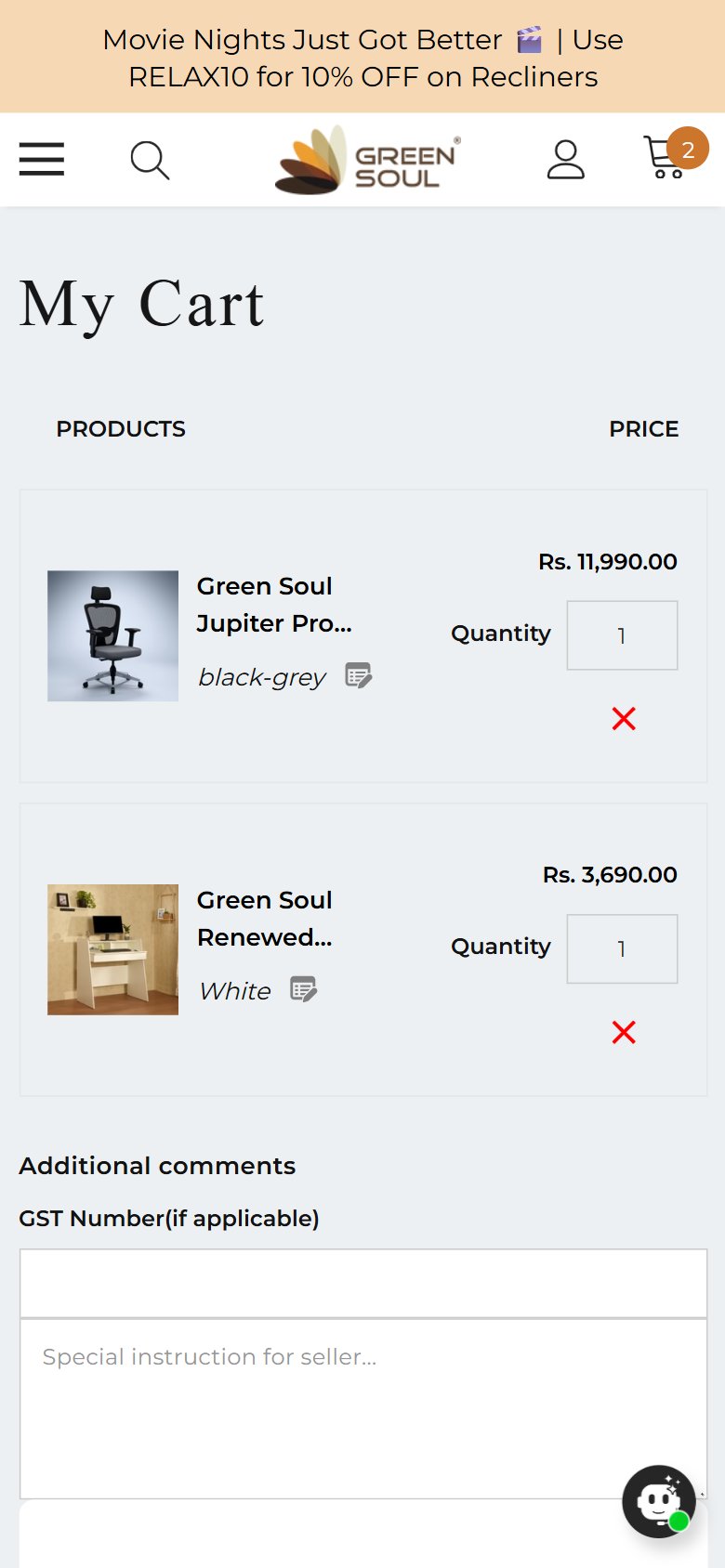
- The cart — both the native /cart page and the Shopflo checkout drawer — lists the chosen items but surfaces no contextual product recommendations.
- The Shopflo drawer handles offers well (milestone/tiered discount progress, coupon suggestions and a total-savings line), but neither the native cart nor the drawer recommends products tied to what's already in the cart.
- Green Soul sells natural add-ons — ergonomic pillows, footrests, caster mats, monitor risers — that pair directly with the Jupiter Pro chair (Rs. 11,990) or a table already in the cart.
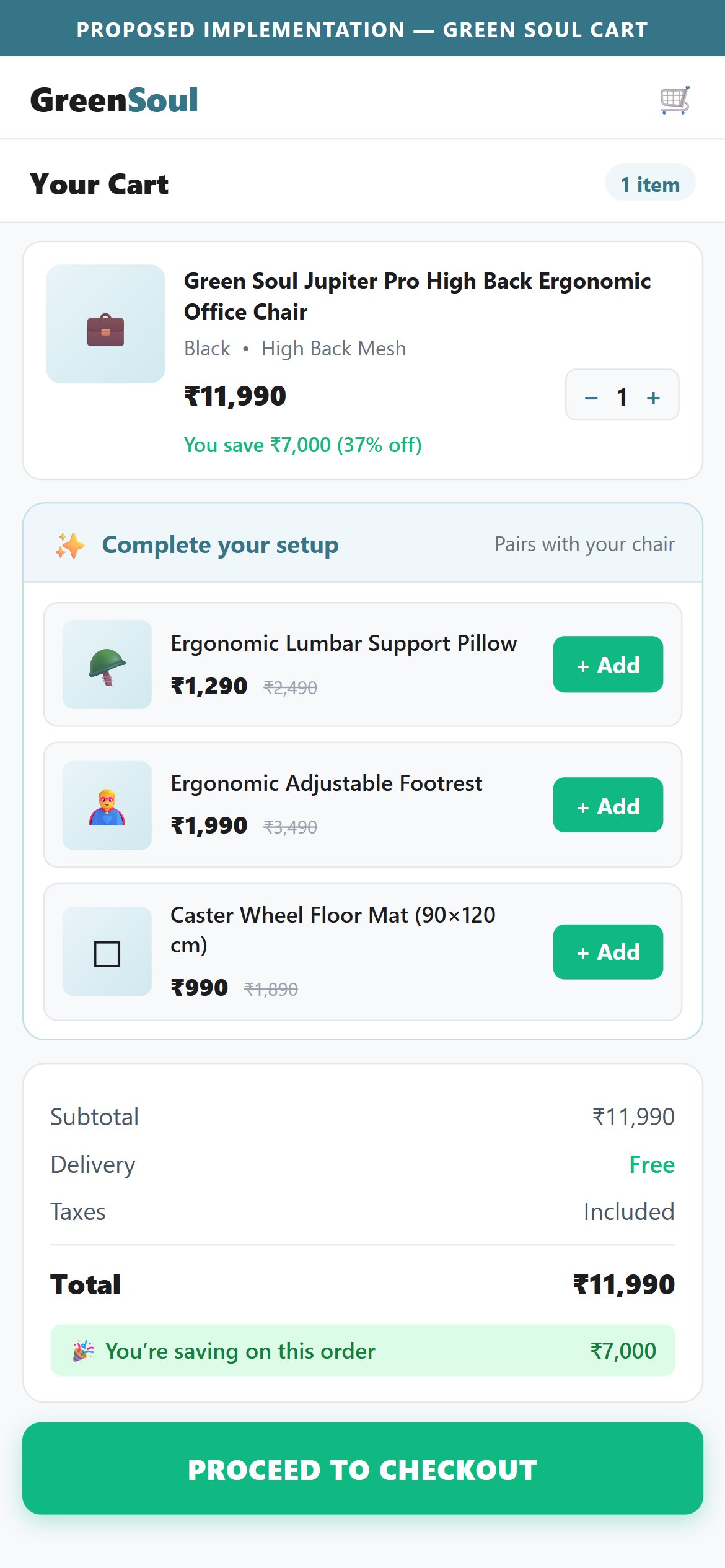
- Contextual 'complete your setup' cross-sell at this high-intent moment is a standard add-on lever for high-ticket furniture.
- Add a contextual 'Complete your setup' strip in the cart drawer — for a chair like the Jupiter Pro (Rs. 11,990) already in the cart, offer one-tap add-ons such as an Ergonomic Lumbar Pillow (Rs. 1,290), an Adjustable Footrest (Rs. 1,990) and a Caster Wheel Floor Mat (Rs. 990).
- Keep it to 2-3 genuinely relevant items so it complements, rather than clutters, the existing Shopflo offer stack.
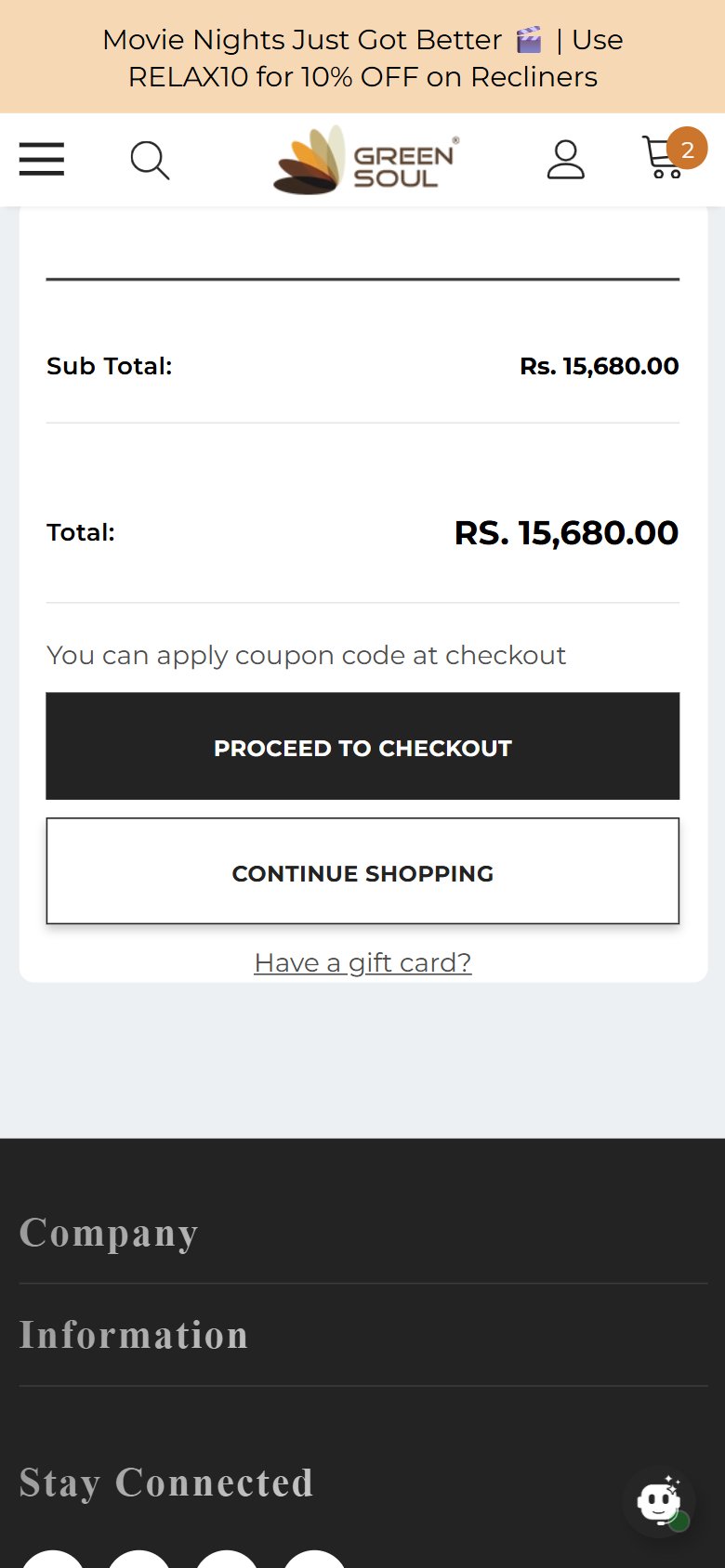
- On the native /cart page the summary lists Sub Total and Total as the same figure (₹15,680), with no line items for delivery, taxes or order savings.
- Coupons are deferred entirely to checkout ('You can apply coupon code at checkout'), so the shopper sees no savings or final-cost clarity on the cart page itself.
- The Shopflo drawer handles this far better (shows savings + estimated total) — the inconsistency means shoppers who reach the native cart get a weaker, less reassuring summary.
- A clear breakdown — subtotal, free delivery, taxes-inclusive, and total saved — reduces pre-checkout anxiety on a high-value order.
- Bring the native cart summary to parity with the Shopflo drawer: show subtotal, 'Free Delivery', taxes-inclusive note, and a 'You saved ₹X' line.
- Expose the coupon field in the cart rather than deferring it entirely to checkout.
App Ecosystem
What's installed vs what's missing from best-in-class Home & Living stores
Present (12)
Missing (4)
App Stack Assessment
Green Soul's app ecosystem is mature: Judge.me reviews with UGC, a Shopflo checkout with strong offers, Snapmint BNPL, an AI shopping assistant, ReelUp video, product comparison and full analytics/pixels. The highest-value additions are a back-in-stock alert (capture demand on sold-out SKUs), a personalized cart cross-sell engine (lift AOV), and a quick-view utility for the deep chair catalogue.
Confidential — Prepared for Green Soul by Growisto | June 2026